

The case for decorating like a four-year-old
Artist Morgane Richer La Flèche on fearless color, leaving law school, and the surprisingly radical act of trusting your own taste

The universe has a funny way of introducing you to people just when you need it the most, and that’s how I met Morgane Richer La Flèche. The friendship meet-cute goes as follows: Each of us shows up to a dinner party in early 2024, where neither of us really knew anyone except the host who invited us (shout out to Ali LaBelle’s pasta dinner in NYC). Both of us were new to the Hudson Valley, both figuring out what it looked like to build a creative life outside of the city. She had just bought a house. I had just quit my job. We talked all night, and, as Morgane would later point out, we have no photos to show for it because it was such a fun night.
Morgane is an artist based in Canaan, New York. She works in oil pastel and hard pastel, paints murals, and has a way of making things that makes you feel like you should be making something too. She also left law school to do all of this (I am always so impressed when I am reminded of this!).
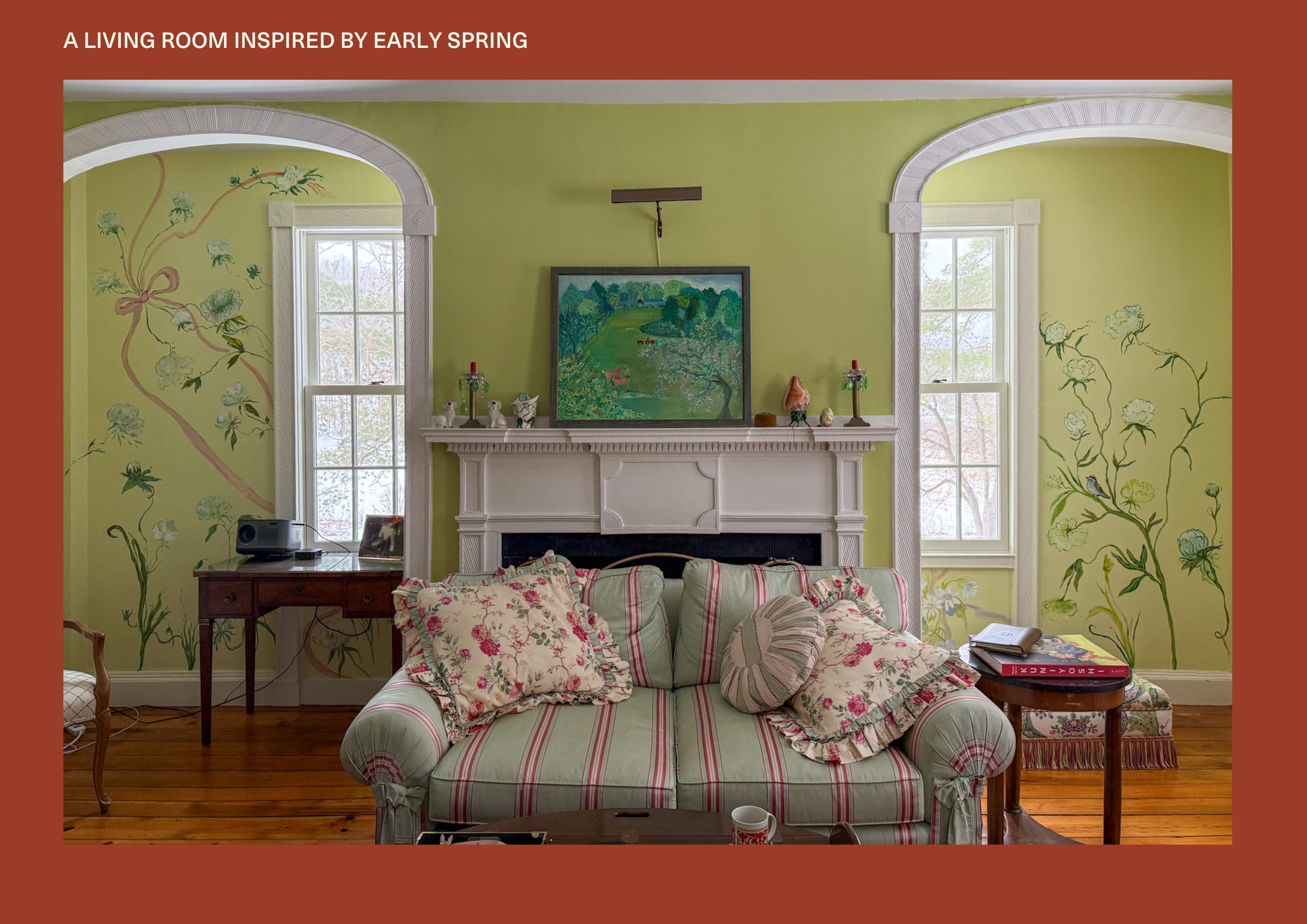
I’ve been wanting to interview her since basically the moment we met, and when I finally got to sit down with her, it was at her house: an 18th-century farmhouse that is, somehow, exactly what you’d imagine if you knew her. Kooky and layered and completely alive with color. Heirloom furniture next to auction finds next to her own paintings on the walls. We were sitting in a room painted the green of early spring buds with snow falling outside, which felt about right for the topic of conversation.
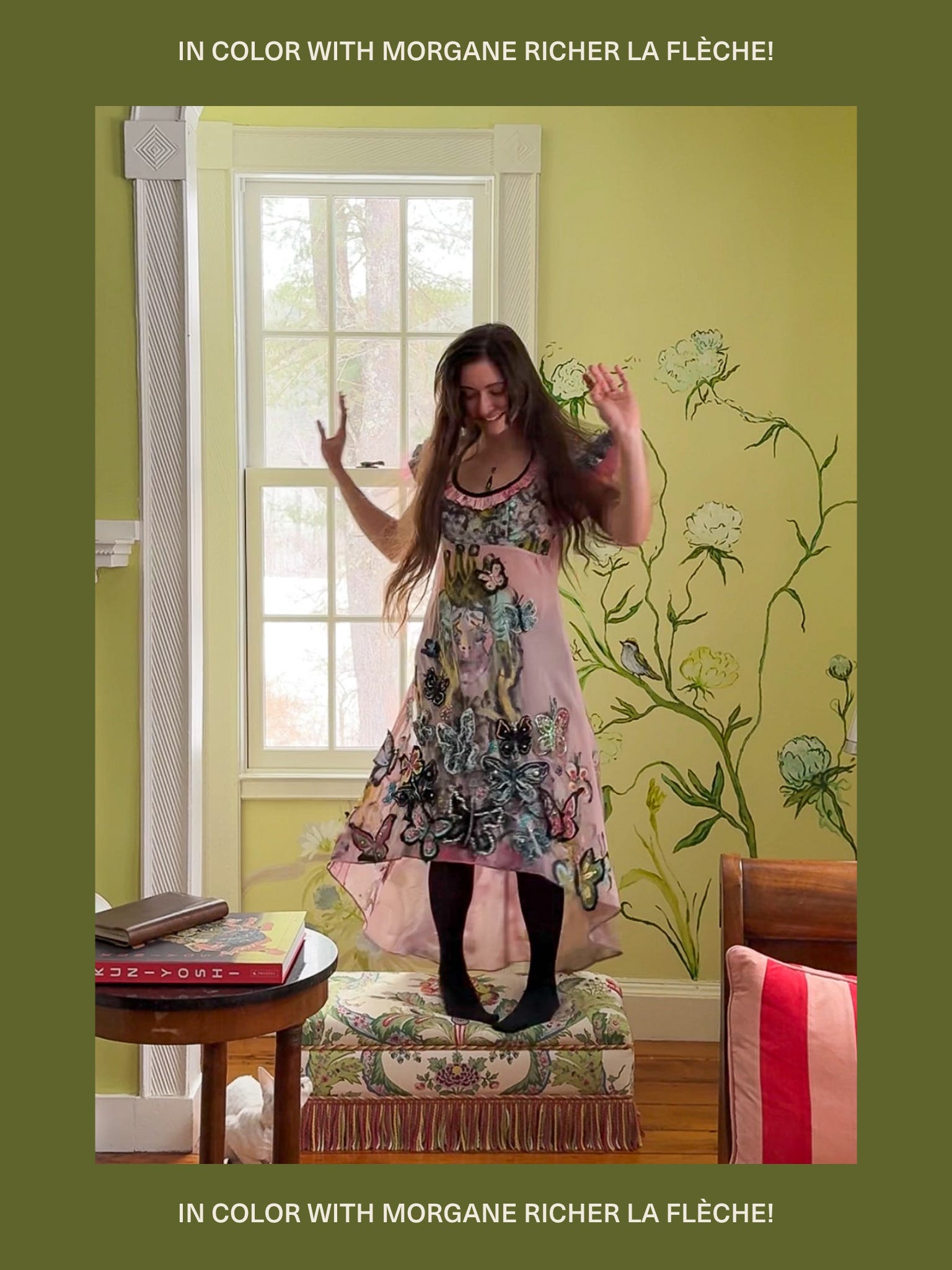
On color in her practice and why being afraid of it is an antisocial impulse:
Tell me about your work and the role color plays in it.
My work is a lot of pastel — oil pastel and hard pastel — but I’ve also done a lot of different projects. Murals are a big part of what I do. Decorative work, like painting corsets for Salter House or making plates with Salon 21. I’ll make puppets or performance pieces sometimes too.
Color in my work is super important. I have a very intuitive relationship to it. I think more is better, and I’m not afraid of it. I’ve always felt really strongly about color, but I read a book a few years ago called Chromophobia — it’s about how the dislike or mistrust of color is so embedded with, honestly, white supremacy and misogyny. It just reaffirmed my conviction that being afraid of color, being afraid of the decorative, is sort of an antisocial impulse. So I am emotionally and intellectually very aligned with color.
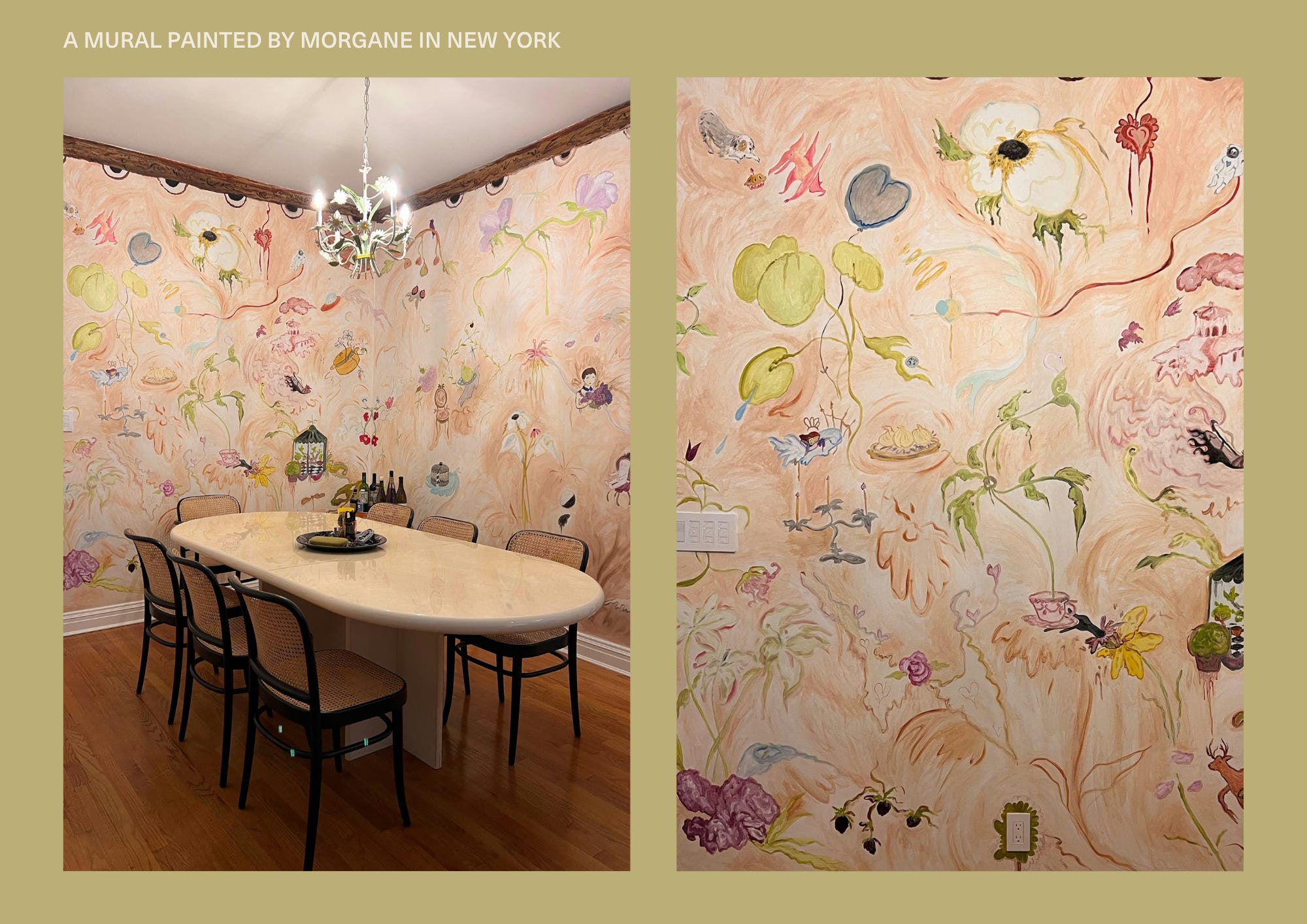
And how did murals become part of your practice? That feels like its own story.
It came out of lockdown. I was stuck at home and couldn’t get to the studio, so I started painting on the white walls in our Manhattan apartment. It had landlord-special white walls, so it didn’t really matter. I just kept going. The whole apartment became the canvas. That got seen on Instagram, and people started asking if I could do the same thing in their spaces. So all of a sudden I was just like, “Oh, okay, sure!” It became this part of my work that I never intended but that I love. The home editor at the New York Post reached out at some point and I ended up as a full centerfold piece. They sent a photographer, the whole thing. And then after that, people started asking for murals more seriously. It grew from there.
When you think about color as a philosophy, not just in your work but in how you move through the world, how do you describe it?
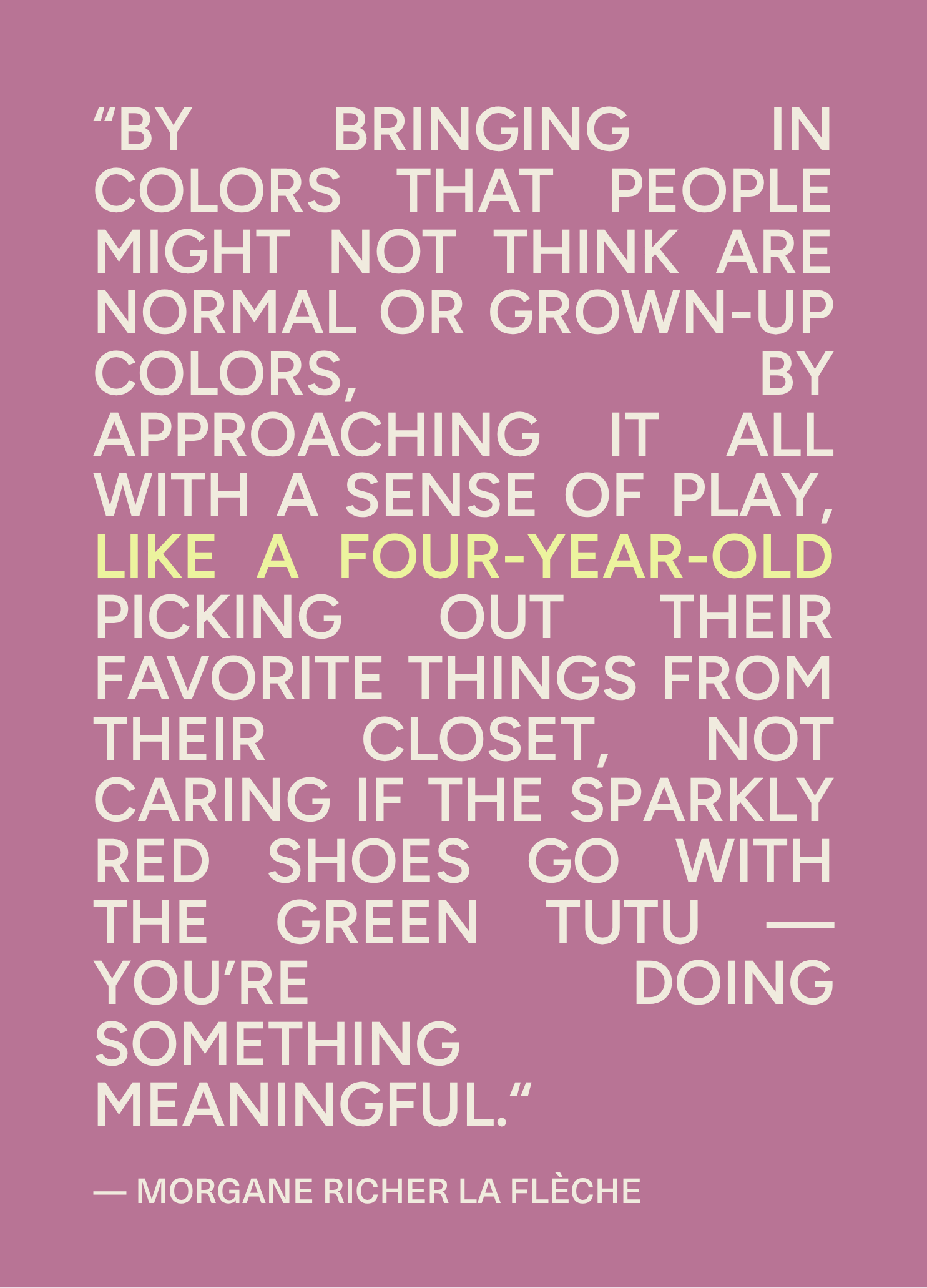
A lot of what matters to me in my art comes into play with the way I use color in my home, which is trying to get at a sense of freedom and possibility. Always. Art at its best creates a sense of possibility, which works against an overwhelming feeling of despair. If things feel unexpected, it cultivates (over time) a feeling that things are possible. So by mixing things however you want, by bringing in colors that people might not think are normal or grown-up colors, by approaching it all with a sense of play, like a four-year-old picking out their favorite things from their closet, not caring if the sparkly red shoes go with the green tutu — you’re doing something meaningful. Just put it all together. It’s your home.

On leaving law school (and having a delusional conviction):
You went to law school, and then you didn’t become a lawyer. Tell me about that.
I always drew, I always painted, but I didn’t seriously pursue it until the pandemic. It was my last semester of law school when everything went remote, which gave me a lot of time in my studio in Brooklyn. I just realized that this was what I wanted to do, and the work was getting really exciting, and I wanted to try it. So I went for it.
How did you actually feel comfortable leaving this world you thought you were going to be in?
I had a delusional conviction. It wasn’t confidence. I was scared. But I had this deep conviction that this was what I needed to do and that I needed to do it now. I remember it was the middle of the night and I turned to my husband Jacob and said, “Okay, don’t freak out.” And I was like, I want to try being an artist professionally. He went quiet and was like, okay. And then we figured it out.
What I did was ask the law firm that I was going to go to to hold my job for a year. And they did. So basically I asked for one year where, if this totally failed, I could still have that job. But if it worked, I wouldn’t go back. After a year, I couldn’t imagine life any other way. So I just said: thank you, I’m not coming.
What gave you the confidence to keep going?
It was actually that people started coming into my life who felt so right, like, people living the life I wanted to live. All of a sudden, I was meeting people with their own studios. People I just immediately felt aligned with. And I was like, if this choice is bringing me closer to people like that, it’s got to be the right path.

On the house (and the door that leads nowhere):
Okay, the house. It’s delightful. How did you find it?
Jacob and I needed to get out of that tiny apartment we’d done the pandemic in. We started looking around New York City, but everything was so expensive for not a lot of space. So we were like, what if we had a place outside the city? We started going upstate on weekends, just casually looking. This was supposed to be a two-year plan. We connected with a real estate agent who sent us a ton of listings including this house, and it didn’t seem like that wonderful from the listing. We rolled up, and the second we walked through the door, we both knew.
It’s an 18th-century house that got an early 19th-century addition in an entirely different style stuck to the back of it. Really interesting owners throughout the years and a literary history. The first American bestseller was written in this house! And the previous owner had taken out two of the bedrooms, so one of the rooms just has a door that leads to nowhere. That door, for some reason, was the thing that sold us.
The thing that sold it for you was literally the weirdest, most unfunctional detail.
It was like, of course there’s a door to nowhere. That’s our house. I think our relationship is very much two people who are really different but who work together. And this house felt like the embodiment of that. So we left in a state of shock, went to Bartlett House, sat outside at the picnic tables, and looked at each other. Oh my god, are we buying a house? And then we just immediately changed our lives around to buy it.

On color in the house (room by room, no restraint):
How did you actually figure out the color palette in here?
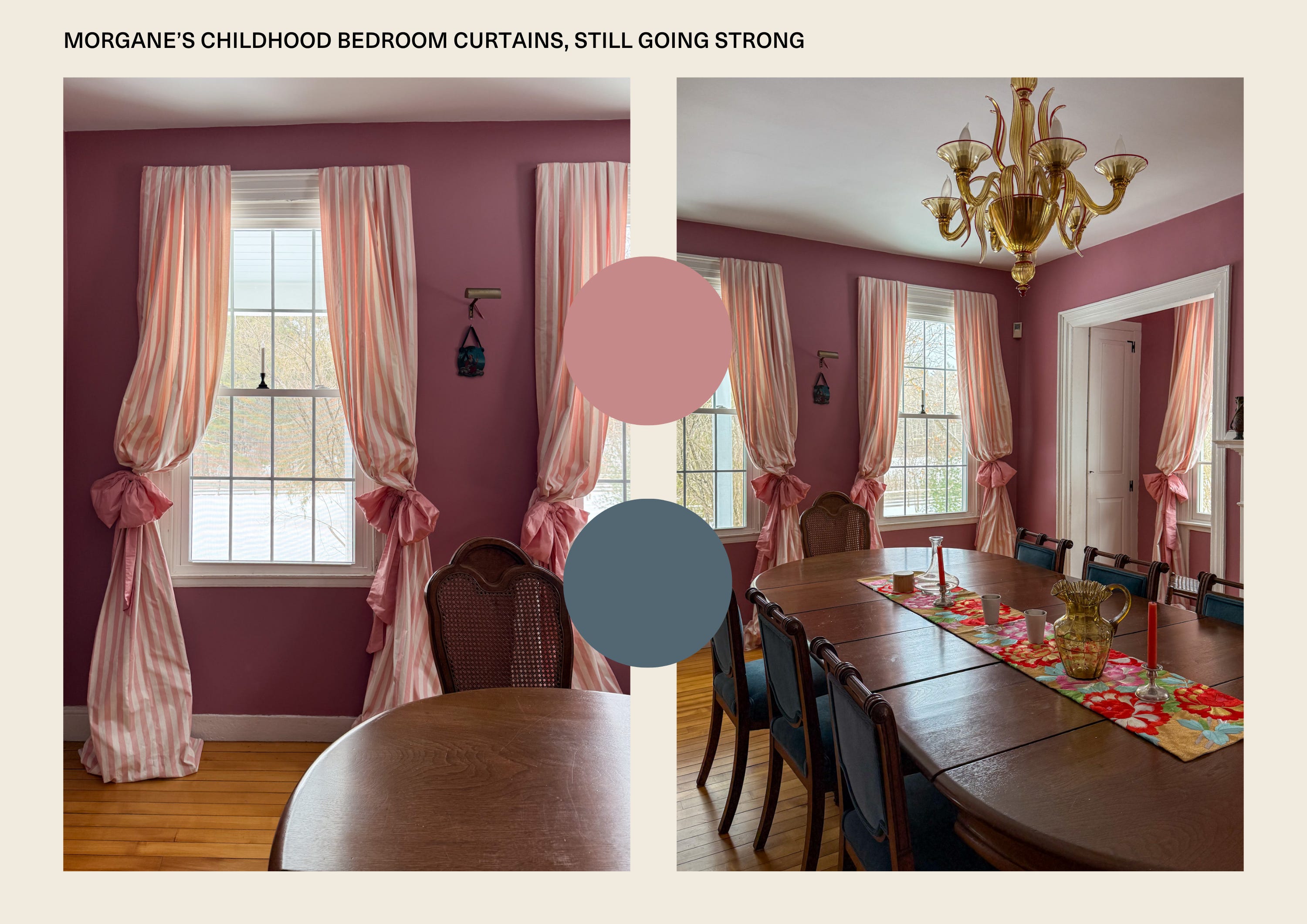
The first room I knew was the dining room. I knew I wanted a pink dining room. And I remembered the curtains from my childhood bedroom that had these big pink bows. I just knew there was going to be a rose dining room with those curtains. I was looking at the Rococo period, the painting The Swing. I wanted a dining room that reminded me of that.
In this room (the living room), I wanted it to feel like a garden, especially necessary during the winter months here. So the green is that early bud green, that first green that emerges. I ended up inheriting a lot of furniture and textiles that were either acid-colored or red, and I thought: that’ll work. It’ll be this interesting zesty thing.
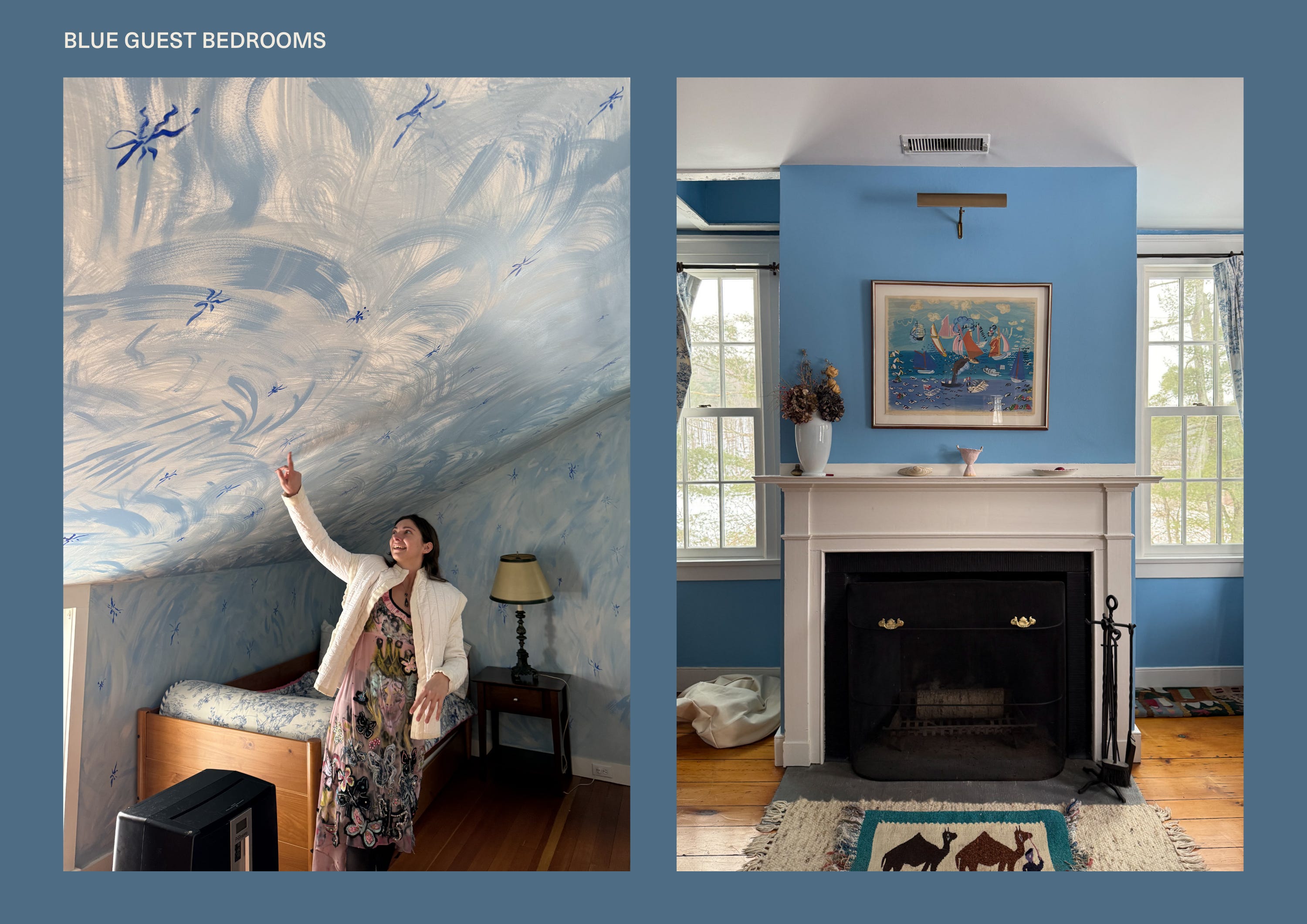
For the guest bedrooms, I did blue — because for people who don’t share my sensibility, that feels like a restful thing to give them. A peaceful, quiet place to rest. And then our bedroom is emerald green, totally drenched in it. Because of the pink dining room I told Jacob we’d do the bedroom in his favorite color. I decided that just fully going jewel tone was the way to avoid the boring sage situation. No restraint.
Did you get any of the colors wrong throughout the process?
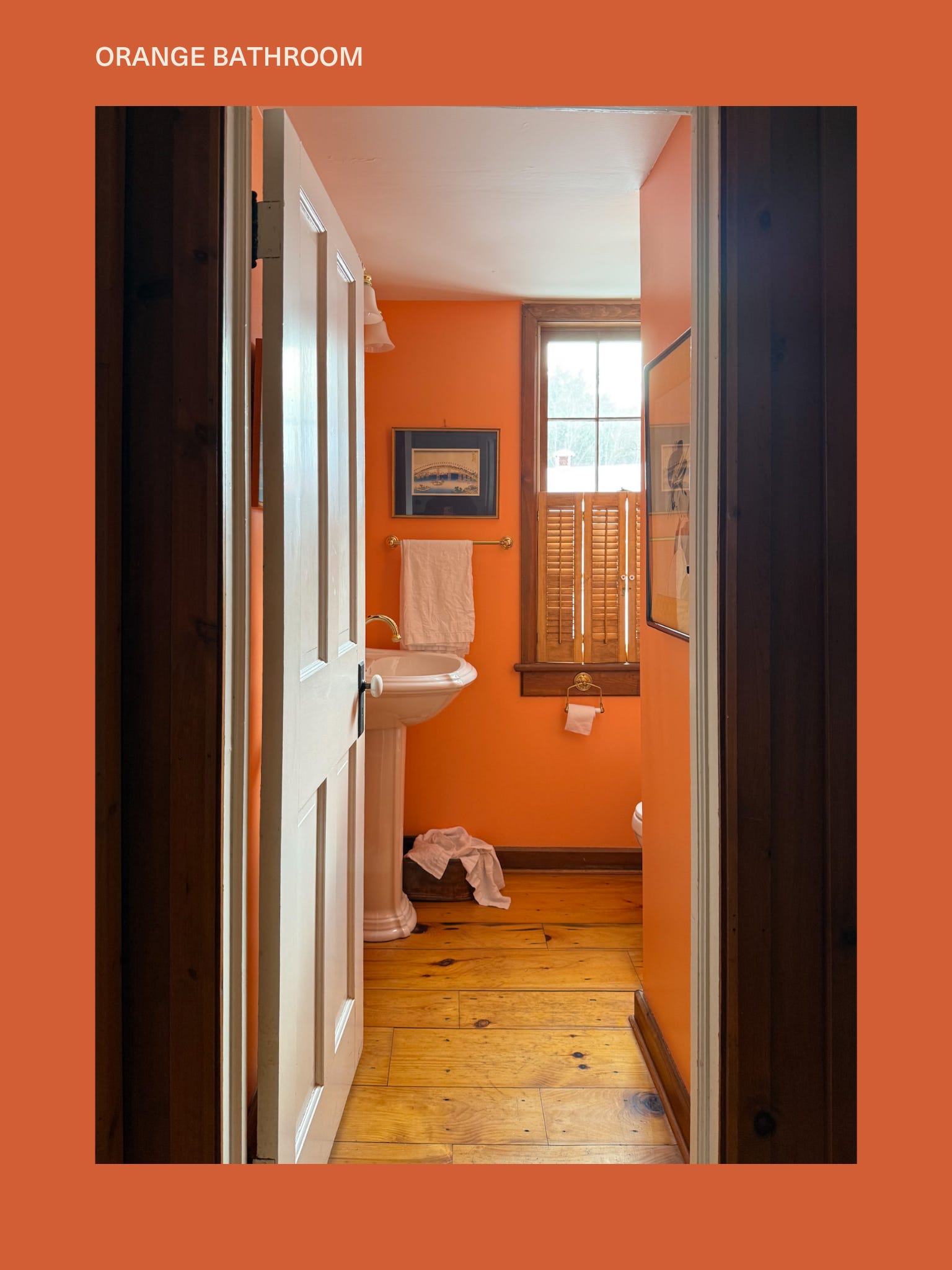
I got the upstairs bathroom wrong. I went with a plum color, and it went dark and flat. This winter I painted it a golden yellow and now it feels so much better. The downstairs bathroom is orange. I chose that color because I wanted a view that would be pretty when you saw the barn. And a full orange room is a lot, but a little bathroom in bright orange? It works.

On collecting and decorating:
Your house seems to be full of heirlooms, auction finds, and things passed down from your family. How do you make it all work together?
I’ve accepted that things are going to be layered. I collect things that strike me. There’s kind of an “oh, that’s really different, that’s really weird” feeling. Sometimes they’re not even in quote-unquote good taste. There’s a miniature cabinet in the other room painted with princesses. I sent it to my friend, and she was like, “This is so weird.” Purchased. Fifty dollars, because no one wants this stuff. But I love it.
The thing is, if you bring all that stuff together and tie it with color, it works. And I use the same strategy when I get dressed. You know how kids get dressed? It’s my favorite jacket and my favorite dress and my favorite sneakers. They’re not thinking about the outfit. They’re grabbing their favorites, and somehow together it works. Instead of trying to work backward from the finished product, put all the stuff you love and let the picture emerge.
And when it comes to the color itself, where do you look for inspiration?
Nature is so helpful because any color combination found in nature is going to work. That’s an easy guide. As an artist, I look at paintings a lot. I look at art history. I looked at 18th-century colors, what was popular in dresses, textiles, and wallpapers. Having those references in my mind, even if the house doesn’t feel true to any historical moment — it’s a contemporary eclectic mix — those guides are still there.

On following your gut (the constraints that are real and the ones that aren’t):
What would you say to someone who’s feeling the pull toward a big life change but can’t get out of their own way?
There are some constraints that are real and some that aren’t. I think people get in their own way a lot by thinking more constraints are real than actually are. The financial piece is real. Can you pay your rent? That’s a real thing. How are you going to get health insurance? Also real. But, are people going to think I’m doing something cool with my life? Not real. Are my parents going to be proud of me? Not real. I’ve already sunk so much time into this path? Not real. It’s about being honest with yourself about which constraints actually exist.
And don’t ignore the feeling even if you’re not ready to do anything drastic yet.
Totally. I love the idea that the things you’re drawn to are telling you something. I would meet people or hear about their lives and feel so pulled toward something I couldn’t even explain. But it was telling me the ways I wanted my life to be different. Even envy gets a bad rap. Maybe you’re scrolling and you feel jealous, but that’s also information. What am I being drawn to that I don’t have?
When I made this shift, all of a sudden my life was full of people where I was like, “I’ve never felt so immediately right and aligned with someone I just met.” And I think what it might actually be is simpler than the universe sending you signs: when you’re honest with yourself about what you’re actually into, you start making choices that bring you there.

Morgane, thank you for sharing your colorful world with us!
If you’re local to the Hudson Valley, you can catch Morgane’s work this weekend (Saturday, May 16 & Sunday, May 17) during Upstate Art Weekend’s Open Studios — more info here. She’s also available for mural commissions and truly should be painting more walls.
And if this conversation cracked something open for you creatively or color-wise, that’s basically the entire reason I do this work. Send me a note and tell me what you’re dreaming up.
xo Daniela
Wow what an amazing story!! So inspiring!! Also those curtains are incredible.
wonderful inspiring interview Daniela...so happy follow your sub stack..always a...colorful...uplift...🤗😉💫🤛🫶